


The Bengali Words and Phrases I Miss Most
Homesickness does not attach itself only to people. It clings to small things: the corner shop, the way a bus conductor shouts, the food you cannot buy anywhere else. I am from Kolkata, the City of Joy, and while I miss the street food (puchkas and jhal muri, I am looking at you), my friends and family, there are two things I miss most: Durga Puja, and hearing Bengali spoken around me.
I am not a native Bengali speaker, and I have been away from the city for a long time. My Bengali is not fluent and my friends find it funny, but I still brighten when I get to use it. When my brother came to stay recently we slipped into Bengali constantly, and I began noting down the words I missed most. Some are so colloquial that I could not explain them alone, so my friend Sumana from My Occassional Musings Blog helped me. Here are thirteen of them, in no particular order of affection.
It begins with a bus conductor
"Aaste ladies kole bachcha" is the phrase that made me start the list. It is what bus conductors call out to alert the driver to slow down (aaste) and stop for a woman carrying a baby in her arms (ladies kole bachcha), usually so that she can get off. It is a small piece of five-star treatment, a way of showing care for women and children in the middle of a crowded bus. I have memories of laughing about it with friends on the way to and from school, and thinking of it still makes me smile.
For people who are a bit much
Haingla, or hyangla, means greedy, usually about food. It can also mean a glutton. As in: "She is such a hyangla for chocolate cake!"
Nyaka has no clean English translation, which is part of why I like it. It covers a range of behaviour, from being a drama queen to being a pansy, to being irritatingly dumb, to pretending to be dumb in order to get attention. It is mostly used about women. Think of the Plastics in Mean Girls, or Poo in K3G: they were nyaka to Bengalis. Nyaka chondi is a step further. Chondi is the goddess Chandi, known for her fierceness, so the phrase suggests a fierce kind of nyaka. I am not sure how many people still use it, but I heard it all through high school and it stuck.
Kyabla means dumb and silly, in the innocent sense. A kyabla in your friend group is a liability if you are planning something secret, because they will give the game away without meaning to. Example: "Kyabla Rahul let his sister play with his phone and now she has seen our photos from the secret cinema trip!"
For things that are excellent
Fatafati means superb, brilliant, awesome: the colloquial way to appreciate something done well. "He is looking fatafati!" "The biryani is fatafati!" Fatiye diyeche is related and means that someone nailed it, killed it, did the thing brilliantly. Question: how was Kohli at today's match? Answer: fatiye diyechhe.
Byapok literally means covering a wide area, expansive. In recent years it has become colloquial shorthand for the same thing as fatafati. "Kolkata looks byapok during the Durga Pujas!"
For things that are wrong
Gondogol means trouble, or the suspicion that something is wrong. "Why is Rohit not returning my call? There must be some gondogol."
Chhatar matha is literally the tip, or head, of an umbrella, but it means nonsense. "I had such high expectations from this film and it turned out to be chhatar matha."
For food, and for weddings
Biye baari te khaabo means "I will eat at a wedding", and it usually arrives with a note of celebration. You hear variants of it constantly: it has been so long since I got to eat at a wedding; when are you planning to get married, it has been ages since I attended one and ate properly. Food is sacred to us, and a wedding is primarily a menu.
Shingara kine niye aaye means "bring some shingaras". A shingara is a snack popular in Bengal, similar to a samosa, though the two are not the same thing. The sweet and snack shops all over the city make it easy to pick up shingaras at short notice, or sweets such as sondesh and mishti doi, whether you have guests or simply a craving.
For telling someone to stop
"Paglamo koro na" and "baaje kotha bolo na" translate roughly as "don't act silly" and "don't talk nonsense". I love any excuse to use them.
Two phrases for Durga Puja
Durga Puja is the biggest festival in Bengal, and I am writing this while it is being celebrated, wondering what my friends and family in Kolkata are doing, how the pandals will be decorated this year, and how the dhunuchi dance will go on the final day. A pandal is a decorative bamboo structure that houses the idols of Goddess Durga and her family; nearly 3,000 of them go up in Kolkata alone, many themed around current events or whatever idea the neighbourhood has settled on.
Pandal dekhte jaabo (pronounced pan-dell) means "I will go and see a pandal", and by extension pandal hopping, which is one of the essential activities of the festival. The city barely sleeps for four days.
Anjali dite jaabo (pronounced on-jo-lee) refers to Anjali, or Pushpanjali, the daily ritual of offering flowers to the goddess and her family. Many people fast through the day until they can visit a pandal, chant the prayers with the priest, make their flower offerings and take part in the aarti.
None of these words is strictly necessary. Most could be translated in a sentence or two, and the city would carry on without them. That is precisely why they are worth keeping: each one carries a tone, a joke or a remembered bus ride that a translation flattens. Hearing them abroad, even in my own imperfect accent, is a small way of being home.
Over to you
If you are from Bengal, or you speak Bengali, what would you add? For everyone else: had you heard any of these before, and which would you try in a conversation? Tell me in the comments.
If you are at Durga Puja this year, tag me on Instagram or use #shareTravellersTales with your photographs. Stay blessed and keep exploring.
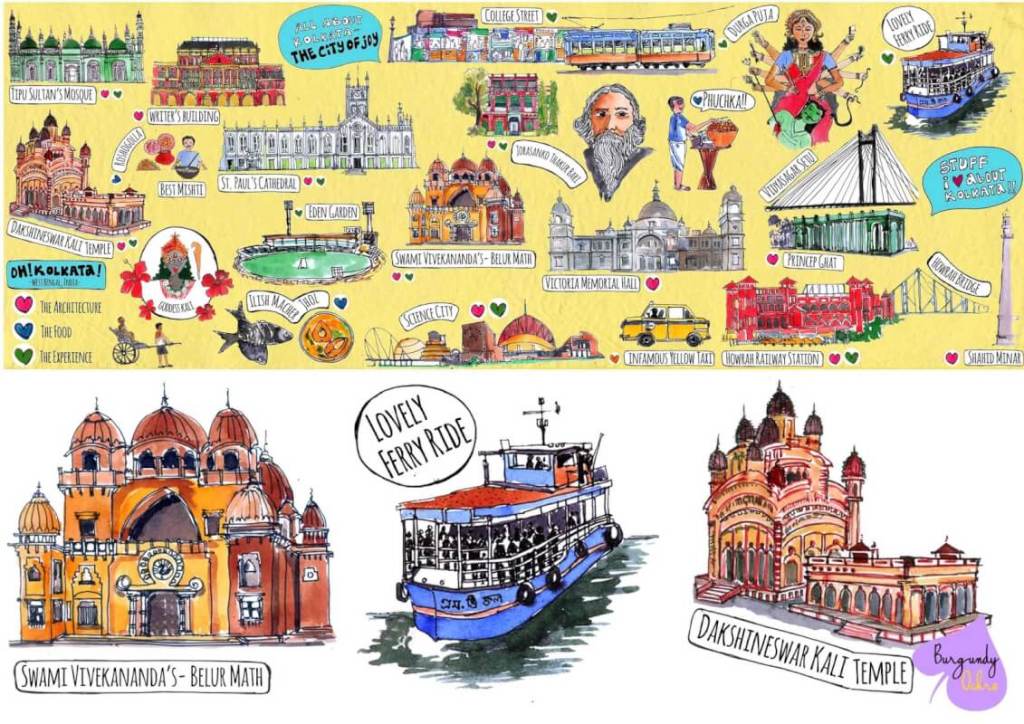
Illustration of Kolkata by Sreoshi Sinha from Burgundy Ochre. Follow her on Instagram and Facebook.
More posts about India
- Things I am asked as an Indian abroad
- What fascinates people about India?
- Five ways the Basel carnival reminds me of Holi in India
Discover more from Europe Diaries
Subscribe to get the latest posts sent to your email.
joshihk
onek bhalo …amibangla shi:kchi olpo olpo…ar proti bochor pujate bengala jayi
Danica Watson
Amazing shots.love to be there.thanks a lot for sharing.
sksojib003
You captured this so well thanks
Abhijit Shevale
Ki sundor..Ami 1 bochor dhare ekhane aachi.. Initially it was difficult to understand but aaste aste buze gelaam.. This post will enrich my vocabulary,as I am a Non-Bengali..
Anjali Chawla
Fatiye diyeche
Richa
Oh this Post was “Fatafati” Enjoyed going through the blog post 🙂
reflectiveponderer
Thanks Richa!:)Glad you enjoyed it!
Upasana Mukherjee
Amusing! You captured this so well!