
A Local's Southern Tuscany Road Trip: Fifteen Stops Through Maremma
Lisa has driven this loop more times than she can count. An Italian mother who writes about her own country at Rome Travelogues, she knows the roads south of Rome the way most of us know our own street, and the route below is the one she keeps going back to.
When a week has been too loud, I fill the tank and drive about two hundred kilometres south. That is the distance between my home and the part of Tuscany that begins just over the border with Lazio, and it is where I go to hear nothing. Yes, you pass the landscape on the postcards — olives, vines, cypresses along the ridge. But the reason I return is the layer beneath: gorges, tombs cut into soft volcanic rock, hot water rising out of the ground, and towns where the houses and the cliff are made of the same stone.
The district is properly called the Maremma, or the Tuscan Maremma, and it belongs to the old Tuscia, the territory the Etruscans shaped, which reaches into northern Lazio and Umbria too. Fifteen places are gathered below. A few are well known to Italians; others you only hear about from somebody's uncle. I have added notes on where to eat and sleep, because around here a good trattoria is not a detail — it is half the reason for the journey.
Before you leave: car, map, season
The right car
I did the whole circuit in a sub-compact with air conditioning that worked and tyres I trusted. Most of the driving is on sealed road, but one wrong turn can put you on a farm track with grass growing down the middle, and that is when decent rubber earns its keep.
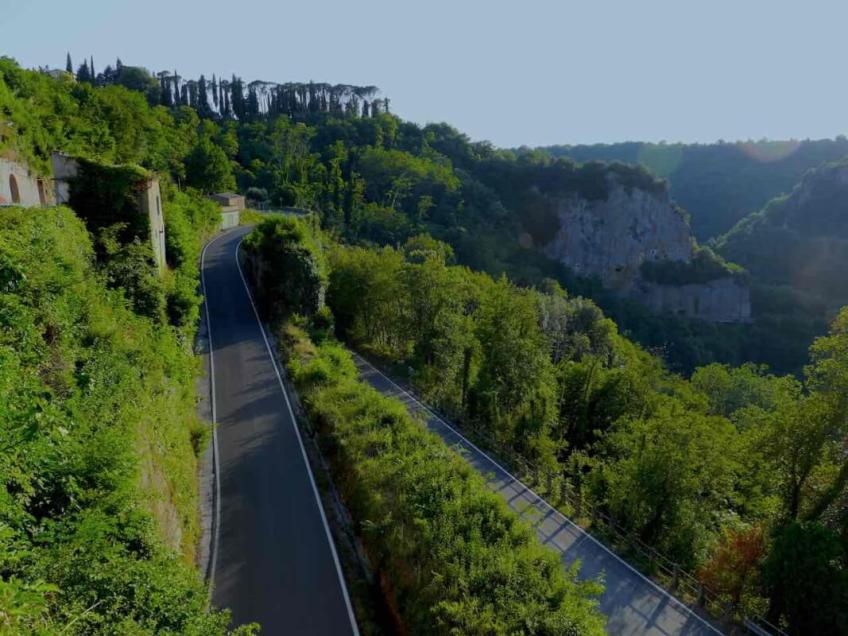
Bring a proper satnav, or download the maps before you lose signal. Google's shortest route has a sense of humour in this countryside and will occasionally aim you at a wall. Wherever you can, stay on the SP roads — strada provinciale — which are maintained and signed. We once got thoroughly lost looking for the agriturismo we had booked, out among open fields, and spent an hour drifting past vineyards and farmhouses with low tiled roofs. We arrived late and did not mind a bit.
Air conditioning is not a luxury. From late spring the air is full of insects, and the large ones, hornets and horseflies, come in through an open window and settle on the dashboard while you are doing eighty. Keep it shut.
When to come
April to June, then September to November. High summer inland is punishing; if July or August are your only free weeks, sleep on the coast and move between beaches rather than villages. One piece of luck: the thermal water is pleasant in spring, summer and autumn alike.
Nine stops in the Archeological Park of Tuff
The park takes in villages, digs and viewpoints in the land between Mount Amiata, the Lazio border and the river Fiora. Tempting as it is to see everything, the three main villages sit only five to ten kilometres apart, and any of them works as a base. Drive to them from the north or the south, in whatever order suits you; the countryside is dense with things to stop for.
1. Sovana, the quiet one
Sovana is the smallest of the three and, to my mind, the most beautiful. Sorano and Pitigliano announce themselves from a distance, whole towns balanced on flat shelves of rock. Sovana does not perform. It has two narrow pedestrian lanes, a piazza with a watchtower and a few shops, and a hush that makes you drop your voice without noticing.
If meditative silence is what you came for, sleep here and drive out each morning.
Four things to see inside the walls: the ruins of the Aldobrandesca fortress, the church of Santa Maria Maggiore, the Palazzo Pretorio and the Duomo. The last is the reason to come. It is among the finest Romanesque buildings in central Italy, and the reliefs on the old gate and along the columns inside repay slow looking — enigmatic figures and symbols that carry traces of influence from right across the Mediterranean.
Beyond the houses, in the wooded gorges that ring the village, stand three Etruscan tombs: the tomb of Ildebranda, the tomb of the Siren and the tomb of the Winged Demons.
2. Sorano
Sorano is hewn from the same stone as everything else here. The town grips a dramatic tuff cliff above the river Lente, similar in shape to Pitigliano but smaller and far more withdrawn. Almost all of it is explored on foot. We left the car at the roadside on the strada provinciale Pitigliano–Sorano, where other cars were already parked, and walked in through the old Jewish quarter, the ghetto of Sorano.
The lanes were empty and photogenic in the way that only old stone can be. Every few doors a small terrace opened over the green valley below, and the alleys led us through arches into the heart of the centre. Two elderly women sat outside their houses talking in a circle; children played near their mothers. Nobody was in a hurry, and neither were we.
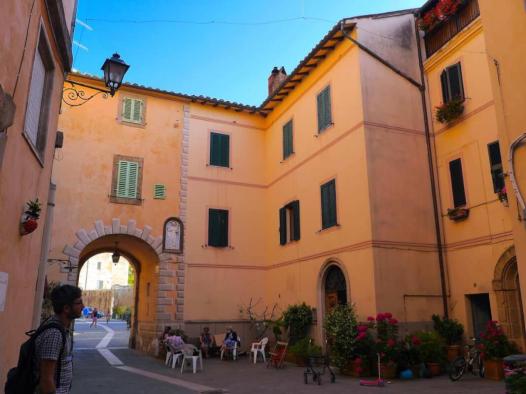
Two things I would not skip. The Orsini fortress, the most imposing building in town, raised in the twelfth century; it now holds the Medieval and Renaissance Museum, a hotel, and the Enoristrò, a bistro serving breakfast, lunch, aperitivo and dinner in the local style. And a glass of wine at a café on the Piazza del Municipio — ours was at La Cantina dei Sapori.
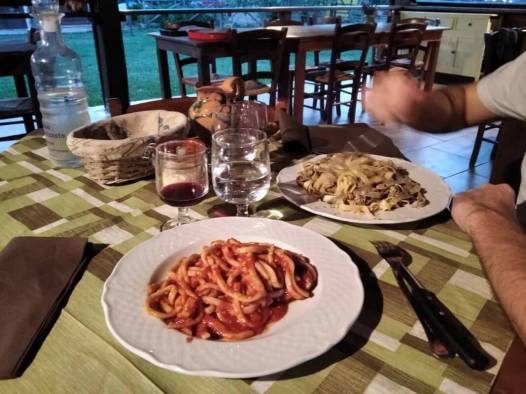
For a real meal, drive out to Agriturismo Aia del Tufo, which cooks only what it grows, certified organic, at prices that feel like a clerical error. It was the best food of the entire trip.
3. Pitigliano
Pitigliano is the largest and the best known of the three, and the first sight of it from the provincial road is one of the high moments of the drive. The town rises off a sheer drop; the houses at the edge are simply the cliff, continued upwards. We stopped twice, once in daylight and once after dark, and neither photograph did it justice. As a defensive position it must have been close to untakeable.
Inside, the pleasure is in getting lost. The alleys are tight and tangled, and every so often a gap between buildings opens straight onto the gorge. Worth seeking out:
- The Medicean aqueduct
- The Fountain of the Sette Cannelle
- The Archeological Museum of Pitigliano, for splendid Etruscan artifacts from the surrounding area
- The workshops and shops along Via Roma and Via Zuccarelli
- The piazza with the cathedral of Santi Pietro e Paolo
- The lanes around the quarter known as Little Jerusalem
For edible souvenirs and a few bottles of local wine, I stopped at Narciso e Bussi, just outside the historic centre, and came away loaded.
Two addresses for a sit-down meal: Ristorante la bontà di Claudia, cucina tipica, and Pizzeria Trattoria La Terrazza.
Where to sleep around the three villages
There are B&Bs inside all of them, but we wanted space, so we took an apartment at Tenuta Roccaccia, a farmhouse a few kilometres from Pitigliano with a kitchen, a pool and vineyards and olive fields on every side. The apartments hold up to five people, and I recommend it without hesitation if you plan to cook for yourselves.
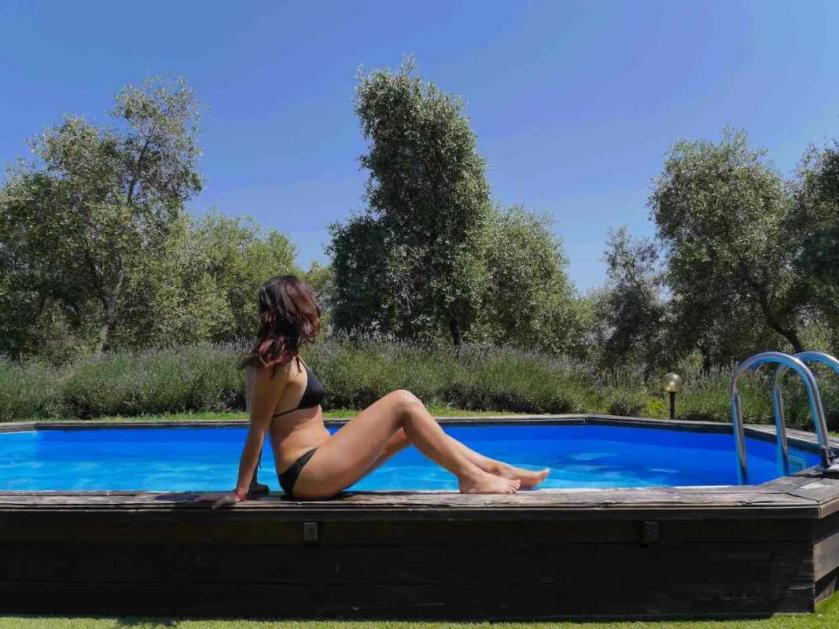
Agriturismo Sovanella has comfortable rooms in a farmhouse deep in the countryside and a cook who is better than she needs to be — we overate, twice. Dinner and breakfast are normally included, though a simple B&B rate exists.
Aia del Tufo, mentioned above, also keeps rooms.
The vie cave: roads cut by hand
The Etruscan cuts, vie cave in Italian, are the strangest thing in this landscape. They are sunken corridors sliced through the tuff with picks, sometimes twenty metres deep and a few metres wide, running alongside necropolises and crossing one another. Nobody is certain what they were for. The Etruscans made them between roughly 1000 BC and the first century BC, and in the Middle Ages hermits and Christian votive niches appeared in their walls. Look closely at the rock and you can still see the marks of the tools, inscriptions from every century since, symbols, and side openings into burial chambers.
More than twenty of these routes survive here, packed around Sorano, Sovana and Pitigliano in a concentration you will not find elsewhere in Italy. They are the archaeological and natural highlight of the whole area.
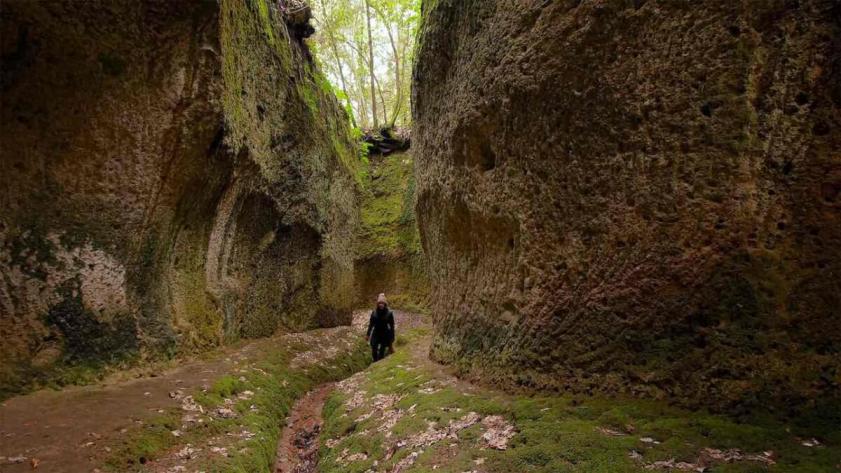
To begin, walk down from Pitigliano into the valley through Porta Sovana and follow the signs for the via Cava di Poggio Cane, then the Via Cava San Giuseppe. Near Sovana, the cuts give direct access to the Tombs of the Siren and of Ildebranda.
The walking is graded easy to moderate, but wear proper shoes — the canyon floor holds water and turns slippery after rain. Much of the route is shaded; in summer take a hat anyway, and bring a torch if you want to look inside the caves you pass.
San Quirico and the abandoned settlement of Vitozza
San Quirico, not to be confused with San Quirico d'Orcia, is a hamlet of Sorano. I drove over one evening to eat at Il Tagliere Etrusco, which these days opens only at weekends, Friday to Sunday. The place was shut, so I walked the village instead and stumbled on the abandoned settlement of Vitozza, which looked worth a return.
The next morning I parked in San Quirico and walked a kilometre to the entrance of the archaeological park. This is the easiest nature walk in the area, almost entirely under trees. The trail passes through prehistoric and medieval remains: dozens of caves facing the path, and the ruins of two castles. Everything is simpler to visit here than the tombs in the vie cave, and the entrance costs nothing. I enjoyed it more than I expected to.
Two kinds of hot water
6. The Saturnia springs
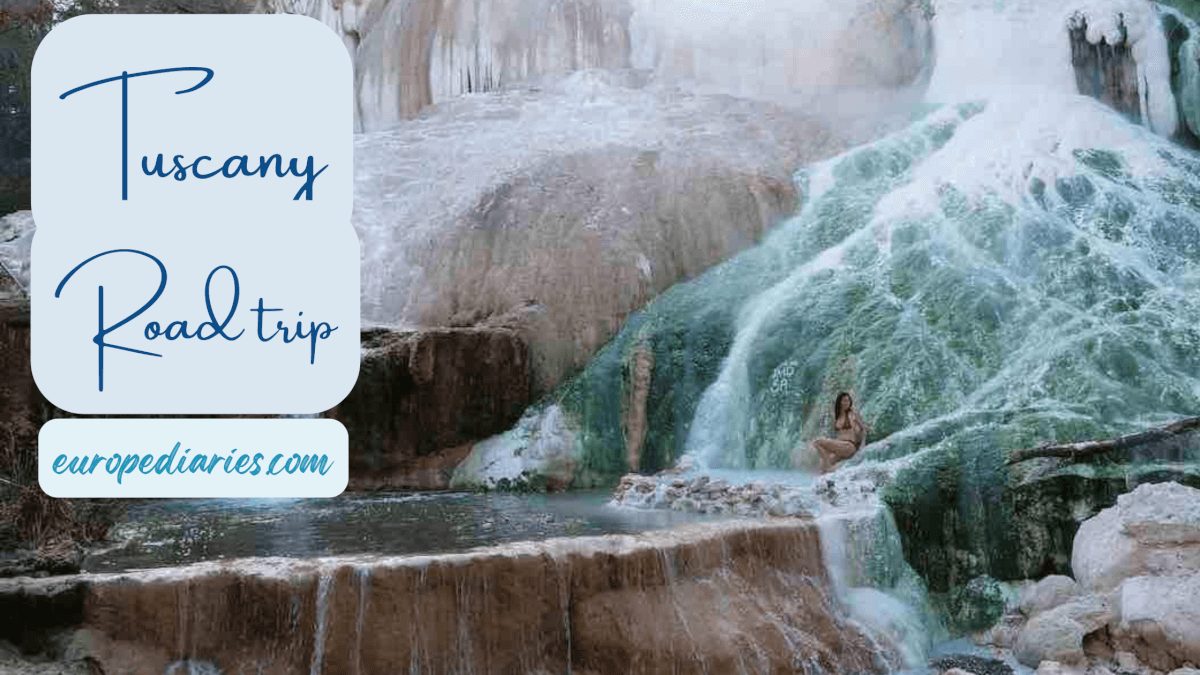
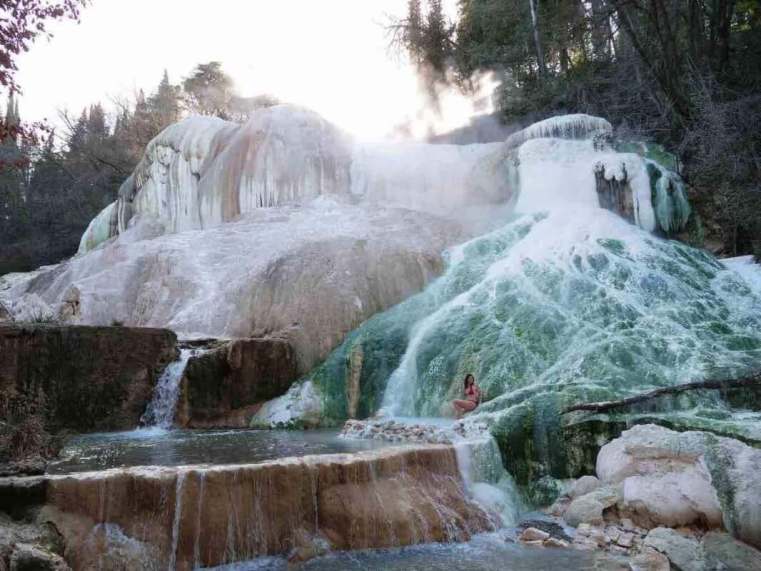
The Mulino waterfalls at Saturnia are famous well beyond Italy, and with reason — they resemble the white terraces of Pamukkale in Turkey. The water holds a constant 25 degrees, access is public and free, and the pools never close. See them in daylight at least once, even though bathing at night is its own pleasure. There are many pools and just as many people; a proper thermal resort stands nearby if you want towels and a bar.
The temperature is right for swimming in spring, summer and autumn, which makes this an easy stop at almost any time of year.
7. Terme di Sorano
Halfway, in money, between the free pools of Saturnia and the polished Terme di Saturnia resort sits Terme di Sorano. It is a recent creation: three big pools at different depths and temperatures, thermal massage jets, and a lawn set out with loungers and umbrellas. Prices are reasonable, and these are among the best thermal baths near Rome. You can also stay at the Terme di Sorano hotel.
At certain times of year they open at weekends only, so ring ahead before turning up.
Manciano, then the Tarot Garden
8. Manciano
The villages above draw plenty of Italian visitors. Manciano, their neighbour, draws far fewer, and it does not deserve to be overshadowed. We drove over hunting a good trattoria and found an intact fortress, the Rocca Aldobrandesca, and a wide view over the surrounding country. We spent a couple of hours wandering the historic centre and looking round the Museum of History and Prehistory of the Valley of the River Fiora, which is free.
For breakfast, wine, aperitivo or local food to take home, Il Covo dei Briganti Biobar is the place.
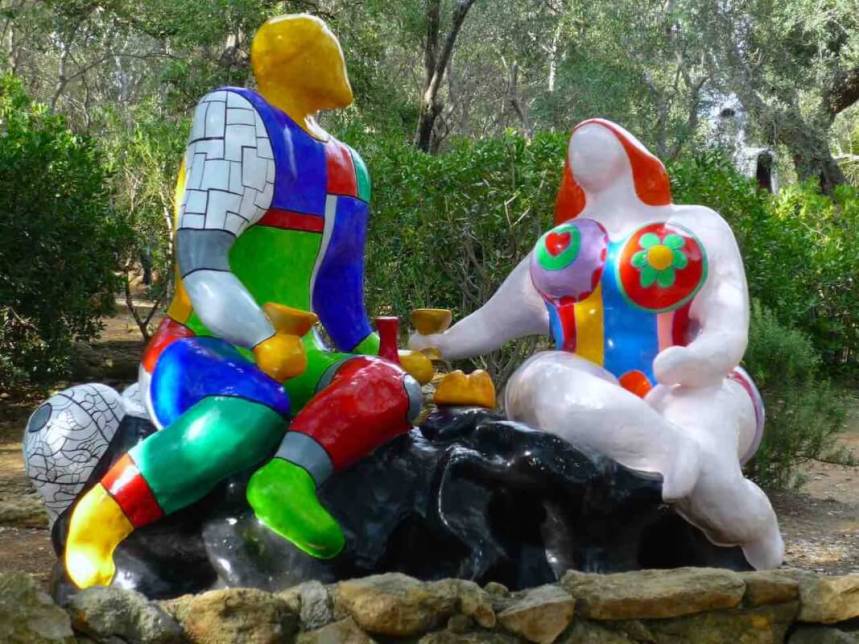
9. Il Giardino dei Tarocchi
Half an hour's drive from Manciano, a few kilometres from the sea, a green hill is covered with twenty-two sculptures and installations. The American-French artist Niki de Saint Phalle gave ten years of her life to this garden, the most important project she ever made. Inside, you walk among giant figures in bright colour: the twenty-two major arcana of the tarot, built from steel, cement, glass and glazed ceramic. She said she drew on the Monster Park at Bomarzo in northern Lazio and on Park Güell in Barcelona. Allow a couple of hours, and bring children — they love it. Entry must be booked in advance through the official website.
Down to the sea
From here the road runs for the coast, past beaches near Rome such as Capalbio and Ansedonia, and on to some of Italy's quietest shoreline: the Argentario peninsula.
Orbetello, and La Feniglia
Three thin strips of land tie the rounded promontory of Argentario to the mainland. Coming from the south, as you will if you have followed this route, the first town you reach is Orbetello.
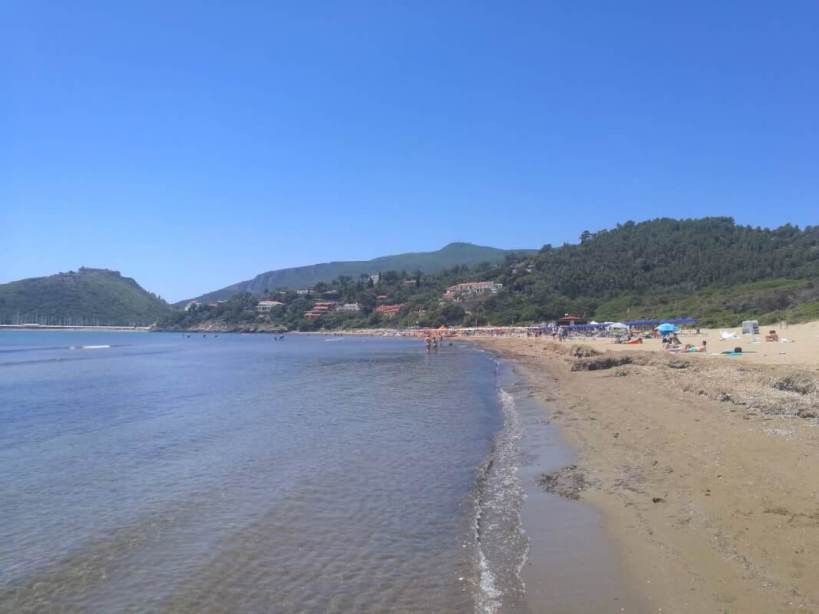
La Feniglia is fourteen kilometres of sand backed along its whole length by untouched pinewood, and it is so wide that finding room to lie down is never a problem. The view works in both directions: on one side the Argentario with a glimpse of the little harbour at Porto Ercole, on the other kilometres of sand and trees running back to the mainland.
You reach it from the car park at the end of the road out of Orbetello, where the Camping La Feniglia also sits — the campsite we stayed on. It is the cheap option, and I recommend it, provided you arm yourself against mosquitoes.
Porto Ercole
There are two main towns on the peninsula. The smaller, Porto Ercole, is the one to make time for. Eat dinner here, have a beer or a gelato, and walk the quay up to the old citadel on a warm evening. It is also the best base in the area.
The little bays
We poked about among the small bays and beaches tucked into the peninsula's vegetation. My favourite was the tiny Cala Gesso. The water in these coves is emerald and clear enough to see the bottom. Reaching them can mean half an hour of walking downhill, so bring trainers, water, food and your own umbrella.
The beaches of the Maremma park
Follow the coast about forty kilometres north and the beaches keep coming, with clean sea all the way. This is the Parco Regionale della Maremma, known for its sand and for pine woods that reach almost to the water.
Two beaches stand out for us. Alberese is the family one: long, broad, easy even with small children. Parking sits close to the sand and costs around two euros an hour by car. Bring lunch — this is a wild reserve, with nothing much on offer.
Cala Violina is smaller and lovelier, and you work for it: about a kilometre and a half through woodland, mostly shaded but with a few climbs. I would only recommend it to people who are reasonably fit and wearing proper shoes. Between May and October you must book through the official website of the nature reserve; entry costs one euro per person plus one euro for the car.
Questions I get asked
How long do I need? Five days is the minimum for a comfortable run; seven lets you stop for lunch and stay for a second glass.
Can I do it without a car? Not really. The villages are close to each other but the sites between them are not served by buses.
Where should I start? Siena or Rome are the natural gateways. Florence works too, though it adds distance. I began at Lake Bracciano, north of Rome, where I was living at the time.
Which village for a base? Sovana for silence, Pitigliano for choice of restaurants, Sorano for a middle path between the two. Any of them puts the others within a quarter of an hour.
Is it expensive? Less than the postcard parts of Tuscany. Agriturismi charge fairly, the springs are free or cheap, and the biggest cost is fuel.
One last piece of advice, and I mean it: go slowly. This corner of Tuscany gives nothing away to people in a hurry. It opens to those who stop the car, get out, and walk a little further than they intended. That is how I found most of the places above, and it is why I keep coming back.
Discover more from Europe Diaries
Subscribe to get the latest posts sent to your email.
Cynthia
I am very interested in the “Southern Tuscany Road Trip”. Is there a map of this route? I would find that helpful. We are most likely starting from Florence and taking approx 3 weeks. I have been intrigued with the heel of the boot-Lecce area…it it worth it to venture that far?
Kirk
Just “WOW!” Impressive and exciting, in fact, so much so that I’m leaving Aix-en-Provence, France and headed your way tomorrow to embark on this itinerary! Wish me good fortune!