
German folklore, region by region: myths, legends and folktales
Mythical Monday returns, this time to Germany. Singing nymphs, imps, werewolves and pirates — the country has no shortage of them. The series began as a personal passion and, to my surprise, brought a great many readers to the blog. Stories are what make a place feel familiar: they attach themselves to a rock, a lake or a street, and after that you cannot pass the spot without thinking of them. Having wandered through Swiss myths and Spanish stories, it is Germany's turn.
First published in 2017. Updated in October 2026.
The Rhine: sirens, a dragon-slayer and a mouse tower
The Rhine carries more legend per kilometre than any other German river. Dangerous water, ruined castles and a long history of travellers have given it a dense stock of stories, and three of the best are gathered in one stretch between Bingen and Bonn.
The Lorelei
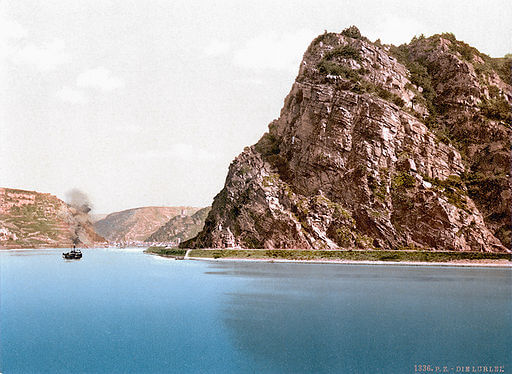
Singing nymphs appear in German legend again and again, and the Lorelei is the most famous of them. Lore was a beautiful nymph who sat on a high rock — a Lei — and sang in a voice that enchanted anyone who heard it. Sailors, drawn towards the sound, lost their balance and fell into the rapids. The rock stands in the Rhine Gorge at Sankt Goarshausen, one of the deepest and most dangerous points of the river, which is presumably why the story settled there.
The tale is younger than it feels. Clemens Brentano invented it in 1801. In his poem Lore Lay, the heroine is betrayed by her lover and accused of bewitching several men to their deaths. Sent to a convent, she asks to climb the Lorelei Rock one last time to look at the river, and falls to her death. Other poets and writers produced their own versions, and a song of the same name followed. I also met the story in Mark Twain's A Tramp Abroad, where he refers to the book Legends of the Rhine from Basel to Rotterdam.
The name probably has a different origin altogether. The river's heavy currents and a nearby waterfall create a murmuring sound, and the rock's echo amplifies it. That is how the rock came to be called Lorelei — the murmuring rock. The Upper Rhine Valley is a UNESCO World Heritage Site.
Siegfried and the Nibelungenlied
The Rhine's most ambitious story is the Nibelungenlied, an anonymous epic written around 1200. Siegfried kills the dragon Fafnir and bathes in its blood, which makes him invulnerable except for one patch on his back where a lime leaf stuck to his skin. That single weakness sets off a chain of betrayal and revenge that ends with the Burgundians destroyed.
The Siebengebirge, south of Bonn, claims the dragon's rock. The Drachenfels — literally "dragon's rock" — has a castle ruin on top and a cave below that guides cheerfully identify as Fafnir's lair. The poem never names the place, so the connection is legend rather than text, but the climb and the view over the river justify it either way.
The Mouse Tower at Bingen
In the middle of the river near Bingen stands the Mäuseturm, or Mouse Tower. Bishop Hatto of Mainz, the story goes, taxed the poor until they starved during a famine. A swarm of mice pursued him to the tower on the island and devoured him there. The first record of the tale comes centuries after the supposed event, and it probably gathered around one of the medieval archbishops named Hatto. The tower itself was a toll station and later a signal post. It is a neat illustration of how German legends work: a real building, a real famine, and a moral fastened to both.
The Lorelei lies further upstream, in the same stretch of river and the same frame of mind — dangerous water, a beautiful singer, and a warning about listening too closely.
The Black Forest: water spirits and a stone from the devil
The Mummelsee
Mummelsee is a glacial lake in the Black Forest, formed during the last Ice Age about 10,000 years ago. Tourists come for it now, but the stories are much older. Set among dark firs, the lake is said to take its name from the water fairies or sprites, though in the local dialect mummel means water lilies.
Alex Württemberger's Legends of the Black Forest describes a king who lives beneath the water with a company of nymphs. They rise to bathe at night, stay below during the day, and sometimes appear on the surface as lilies. When the spirits are angry the water seethes — as it did when a peasant fell in love with a nymph and tried to find out where she came from. Some versions say the nymphs are the nuns of a monastery that once stood there, and that the lake swallowed the monastery after a nun fell in love with a farm boy.
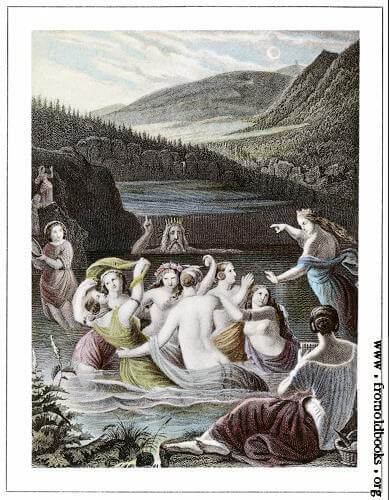
Other beliefs from the region are worth recording. At Bollschweil, in the middle of the forest, the Devil's Stone (Der Teufelsstein) is a red rock supposedly supplied by the Devil himself to lay the foundation of a fountain after he lost a bet. Between Wildgutach and Neu-kirch-Fallengrund stands a beech tree with a stone bust of Jesus apparently growing out of it, which draws pilgrims every year. The Rhine Maidens, or Rheintöchter, are water spirits of the Rhine, usually pictured as three sisters.
Town tales: rats, straw and a masquerade
The Pied Piper of Hamelin
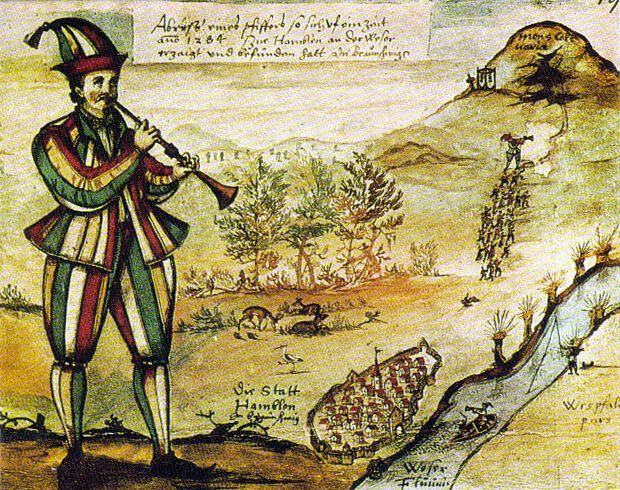
Anyone raised on the Brothers Grimm already knows a good deal of German folklore, and the Pied Piper is among the best known of all. The story is set in 1284 in Hamelin, a town in Lower Saxony, and it does appear to have some historical foundation.
In the familiar version the piper rids the town of rats with his flute. When the town refuses to pay the full sum promised, he returns for revenge. On the feast of Saint John and Paul, 26 June, he plays again and leads every child away, never to be seen again. Of about 130 children, one is left behind because he is lame and cannot keep up, and so lives to tell the tale. Some versions leave two more: one deaf and one blind.
The earliest record is a stained-glass window in Hamelin's church from around 1300, destroyed in the 17th century. Theories multiply. The children may have died of natural causes, with Death personified as the piper. The disappearance has been linked to Dancing Mania, a mass psychogenic illness, and to a pagan sect said to have led the children to Coppenbrügge — the "Koppen" hills — where a landslide or similar disaster killed them. The street where they were last seen is called Bungelosenstrasse, "street without drums", and music and dancing are still not allowed there. If the story rests on real events, what happened?
Rumpelstiltskin
A miller, eager to impress the King, boasts that his daughter can spin straw into gold. The tale comes from the Grimms' collection and is estimated to be about 4,000 years old. The King locks the girl in a room full of straw with a spinning wheel and orders her to spin it all by morning or face punishment. An imp-like creature appears and offers to help in exchange for her necklace. The King is delighted, then locks her in a larger room; the imp returns, this time for her ring. A third and larger room follows, with a promise of marriage. Now she has nothing to give, so the imp asks for her first-born child.
Years pass. She becomes Queen and gives birth. The imp arrives to claim the child, and she begs him to take any wealth instead. He sets a condition: if she can guess his name within three days, she keeps the baby. The first two days of guesses fail. She goes into the forest — or sends a trusted officer, depending on the version — and finds him dancing and singing: "Tonight tonight, my plans I make, tomorrow tomorrow, the baby I take. The queen will never win the game, for Rumpelstiltskin is my name." The next day she names him correctly, and he disappears in a rage. Versions of the story exist in England, Russia and Iceland as well.
The Knave of Bergen
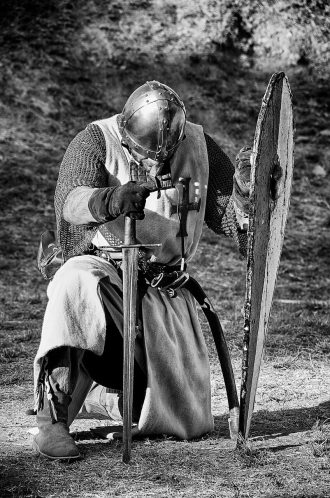
Frankfurt once held a grand masquerade in honour of a prince's coronation. Knights and princes filled the room, and the atmosphere was all nobility and fervour — until a tall knight in black armour appeared. He was poised, modest and graceful, and he bowed before the Queen and asked for a dance. She agreed, then another, then a third and a fourth, while the room's curiosity rose.
At the hour of revelation every man had to unmask. Nobody recognised the stranger until two officials gasped: it was the executioner of Bergen. The King, enraged, ordered his execution. The man proposed a remedy instead: knight me, he said, and I will throw down my gauntlet for anyone who speaks disrespectfully of you. The King, surprised but persuaded, replied that he had acted knavishly and that Knave of Bergen he should be.
I first met this story four years ago in Mark Twain's A Tramp Abroad, which cites Legends along the Rhine from Basel to Rotterdam; my retelling is adapted from there. There is a glimpse of Frankfurt elsewhere on the blog.
The Spectacular Ruin
Twain also mentions Erbach, an hour from Heidelberg, and its "Spectacular Ruin". In the Middle Ages, the story goes, a dragon lived in the town and devoured men and cattle as it pleased, and no one could defeat it. The Emperor promised any reward to whoever destroyed it. Knights came from far and wide and were eaten one after another.
Then came Sir Wissenschaft, an obscure knight carrying a strangely shaped knapsack. The King warned him that this was no easy task and suggested he hunt hares instead of walking into danger. "Were any of the heroes men of science?" the knight asked, to general laughter. Told to take a spear and leave the knapsack behind, he replied that it was not a knapsack, and that spears were useless to men of science. He had studied dragons in a series of experiments; the knapsack was a fire extinguisher, which he threw into the centre of the dragon's mouth until the creature curled up.
Ask what you want, the King said. The knight asked for a monopoly on the manufacture and sale of spectacles in Germany. The King was taken aback but kept his word. The scientist was not selfish, and made spectacles affordable for everyone; the King was so pleased that he ordered everyone to buy a pair, needed or not. That is the origin of the "Spectacular Ruin". If you are in the region, here is why I think you will love visiting Heidelberg.
Werewolves and pirates
The Morbach Monster
Wittlich, in the Morbach municipality, has a werewolf story of its own. A soldier deserting the Russian army stopped there with other deserters on his way home to Alsace. They decided to take supplies from a farmhouse, were caught in the act, and killed the farmer and his sons. The farmer's wife cursed the soldier to turn into a beast at every full moon.
Word of a violent animal spread, and the people of Morbach eventually killed it. A candle burned at the spot where it was buried as a reminder and a warning. One night in 1988 the candle went out. Officers at the US airbase at Morbach reported a huge wolf-like figure inside the perimeter; a chase followed, and the military dogs could not deal with it. The candle was relit and the story has been retold ever since.
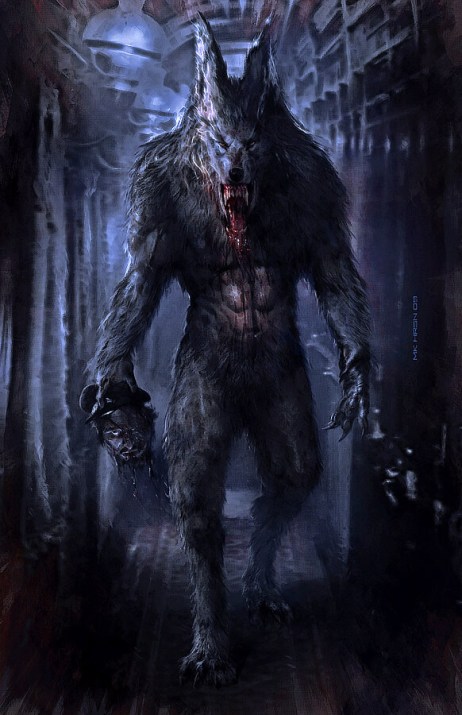
It may have been three bored security officers inventing something to pass the shift, but some of them insisted years later that the sighting was real. A detailed account exists, and someone even sent a personal version to a folklore site.
Klaus Störtebeker, Hamburg's pirate
Hamburg's streets carry the legend of Nikolaus, or Klaus, Störtebeker, a pirate of the North in the late 14th century. He plundered Hanseatic ships, could down four litres of beer at once — hence the surname — and was extremely hard to catch. He seems to have thought of himself as a Robin Hood, robbing the rich for the poor.
After years of raids across northern Germany, his ship was caught near Heligoland and the crew was brought to Hamburg for trial. Störtebeker was sentenced to death and granted a final wish before execution at Grasbrook, now partly HafenCity. He asked to be beheaded first, on the condition that any crew member his headless body managed to walk past would be pardoned. Headless Klaus got up and walked past 11 of his men before the executioner tripped him. The mayor broke the promise and executed all 73, the 11 included. Some of the ship's treasure is said to have gone into the tip of St Catherine's church in Hamburg; perhaps more lies buried beneath it.
Visit Hamburg and an old-town tour such as the Hamburg Discovery Tour will show you the church and tell the story; my own favourite is the walking tour for Harry Potter and magic fans. His statue stands in HafenCity, and you can drink a beer at the Störtebeker bar in the Elbphilharmonie, or join a food tour that ends at the Störtebeker restaurant. In 1878 a skull was found in HafenCity, raising the possibility that it belonged to him. If you hear more eerie stories on the Haunted Hamburg tour, do tell me.
Before the fairy tales: the older gods
Long before the Brothers Grimm, the lands that became Germany had a pantheon. Tacitus, writing his Germania around AD 98, described the gods of the tribes east of the Rhine: a sky god the Romans identified with Mercury, a thunder god, and a goddess associated with marriage and the household. Their old German names survive in the days of the week — Tuesday from Ziu, Wednesday from Wodan, Thursday from Donar, Friday from Frija.
Very little pagan German literature survived the Christianisation of the eighth and ninth centuries. The two Merseburg Incantations, copied in the ninth or tenth century, are the only known Old High German pagan spells to have come down to us; one is a charm for healing a horse's dislocated leg. Most of what is now called Germanic mythology reaches us through Norse sources written in Iceland, above all the Poetic Edda and the Prose Edda. That is why German and Norse myth overlap so much: the same gods, the same giants, the same world-ending fire, remembered in different languages.
Mountains: Rübezahl, the Brocken and Frau Holle
Rübezahl
Rübezahl is the mountain spirit of the Giant Mountains — the Riesengebirge, or Krkonoše — on the old border between Silesia and Bohemia. He shifts shape at will: giant, monk, wandering peasant, gust of wind. He rewards the poor and honest and punishes the greedy and arrogant. His name is usually derived from Rübe (turnip) and zählen (to count), from a tale in which a clever girl keeps him busy counting turnips while she escapes his service. Stories were in print by the sixteenth century and were collected more systematically in the seventeenth. He belongs to German, Czech and Polish folklore at once; the Czechs call him Krakonoš.
The Brocken and Walpurgisnacht
The Brocken, at 1,141 metres the highest peak in the Harz, is the most famous witches' mountain in Germany. On the night of 30 April — Walpurgisnacht, named after the eighth-century English missionary Saint Walpurga — folklore says the region's witches fly to the summit and dance with the Devil. Goethe climbed the Brocken in 1777 and used it for the Walpurgisnacht scene in Faust, fixing the image in the German imagination.
The story is probably older than the saint. The night sits exactly halfway between the spring equinox and the summer solstice, one of the old turning points of the agricultural year, and the Church seems to have placed a saint's feast on top of a pre-Christian festival. The mountain now fills with hikers, some in costume, and the Harz tourist board leans happily into the legend. The summit has a colder modern history too: during the Cold War it was a closed military listening post on the inner German border, which kept it off-limits for decades and, paradoxically, preserved its mystique.
Frau Holle and the Wild Hunt
Frau Holle is one of the few German figures that English-speaking readers already know, thanks to the Grimms' tale in which a kind girl shakes her feather bed and makes it snow on earth. The story is usually attached to the Hoher Meissner, a basalt plateau in Hesse, where Holle is said to live in a cave or under the mountain with her servants. Other versions make her Holda, a goddess of spinning, flax and the household, and her winter procession overlaps with Perchta's in the south.
She is also linked to the Wild Hunt (Wilde Jagd), the spectral cavalcade that thunders across the night sky during the Rauhnächte, the twelve nights between Christmas and Epiphany. In some regions the hunt is led by Wodan, in others by Frau Holle or Perchta; the common thread is that the living should stay indoors, keep quiet and leave the dead their passage. The Rauhnächte are still observed in parts of Bavaria and Austria, less as fear than as a season for smoke, incense and quiet.
The Grimms did much of their collecting while working as librarians in Kassel, in this same region. Their first volume of Kinder- und Hausmärchen appeared in 1812, the second in 1815. Many of the tales came from middle-class informants such as Dorothea Viehmann, and Wilhelm Grimm edited later editions heavily, smoothing the stories into the nursery versions we know. The Grimmwelt museum in Kassel is the best place to see how that editing process worked. An article in The Guardian makes the point that most of these stories were originally violent and adult, and were adapted for children as norms changed: the evil queen who wanted Snow White killed was her own mother, and Cinderella's sisters cut their feet to fit the glass slipper.
The Alps: Krampus, Perchta and the Wolpertinger
In the Bavarian Alps, folklore is not a museum piece. It is performed in the street every winter.
On the evening of 5 December, the night before St Nicholas's Day, young men in carved wooden masks and heavy fur suits run through the streets as Krampus, the horned, chain-rattling companion of St Nicholas who punishes children who have misbehaved. The Krampuslauf, or Krampus run, is still held in Munich, Berchtesgaden and dozens of Alpine villages, and the masks are often family heirlooms carved by local craftsmen.
A few weeks later, on the eve of Epiphany, the Alpine winter belongs to Perchta, also called Berchta or Frau Bercht. She is a far older figure than Krampus: a white-robed woman who leads a procession of masked Perchten through the villages, rewarding the industrious and punishing the lazy, especially girls who have not finished their spinning by the end of the year. In some regions she is benevolent; in others she carries a knife and is used to frighten children into bed. The Perchtenlauf is still performed in Bavaria, Salzburg and the Tyrol.
The Wolpertinger belongs to a gentler tradition: a small creature assembled from a hare, a roebuck, a pheasant and a squirrel, existing mainly as a mounted trophy in Bavarian hunting lodges and taverns, where landlords competed to make the strangest specimen. It is folklore about folklore — a joke told with a straight face, and a reminder that not every German legend was ever meant to be believed.
Then there is the Tatzelwurm, the "claw worm" of the Alps: a cat-headed serpent said to live in caves and high pastures, sometimes reported in Bavaria, Austria and Switzerland. Sightings have been claimed for centuries, but no specimen has ever been produced. Naturalists generally put the stories down to misidentified animals, hoaxes and the human talent for seeing a monster in a shadow.
The coast: a ship's kobold and two drowned towns
Sailors on the North Sea and the Baltic told of the Klabautermann, a small ship's kobold in a sailor's jacket and cap who lived in the hold, helped with repairs and gave warning before a storm. To see him was generally a bad sign: he showed himself when the ship was doomed. The belief was widespread enough that a vessel without a Klabautermann was thought unlucky, and the word survives in German as a mild insult for a grumpy, tinkering old man.
The Baltic coast has its own drowned cities. Vineta, said to have been a rich trading town on Usedom or Wolin, was supposedly swallowed by the sea as punishment for the pride of its people; on calm nights, legend says, you can still hear its bells under the water. Rungholt, in the North Frisian Wadden Sea, is the rarer case of a legend built on a documented disaster: the town was destroyed in the storm flood of 1362, and its church tower, bells and farmland have been found in the mud centuries later. The moral is the same — prosperity, sin, water — but Rungholt warns us that the sea never needed a legend to be dangerous.
Fairy tale or legend?
German distinguishes two kinds of traditional story, and the difference matters when reading about German folklore. A Märchen happens "once upon a time", in no particular place, and is built for wonder: talking animals, wishes, a youngest child who succeeds. A Sage is tied to a real place or person — the Brocken, the Lorelei rock, Bishop Hatto — and usually insists that it happened. Fairy tales were told to entertain; legends were told to explain a landscape, warn against danger or keep a community in line.
The Grimms collected both, but the Kinder- und Hausmärchen made the fairy tales world-famous, which is why "German folklore" in English so often means fairy tales. The regional legends gathered here are the other half of the tradition: local, place-bound and often darker. Together they explain why a country with so many forests, rivers and ruined castles has so many stories about people who should have stayed on the path.
Questions about German folklore
What is German folklore best known for?
It is best known for the fairy tales collected by the Brothers Grimm, and for place-bound legends such as the Lorelei on the Rhine, the Pied Piper of Hamelin, Rübezahl in the Giant Mountains and the witches of the Brocken on Walpurgisnacht.
Is Germanic mythology the same as German folklore?
No. Germanic mythology is the pre-Christian religion of the Germanic peoples — gods such as Wodan, Donar and Frija — known mainly from Roman writers and Norse sources. German folklore is the later body of fairy tales, legends and customs, much of it recorded in the nineteenth century and shaped by Christian and regional influences.
Who are the main figures in German folklore?
They include the Lorelei, the Pied Piper, Frau Holle, Rübezahl, Perchta and Krampus, the Klabautermann, the Wolpertinger, and the Wild Hunt led by Wodan or Frau Holle. Many are regional: Krampus and Perchta belong to the Alps, Rübezahl to the Giant Mountains, the Klabautermann to the coast.
What is the difference between a fairy tale and a legend?
A fairy tale (Märchen) is set "once upon a time" in no fixed place and is told for wonder and entertainment. A legend (Sage) is attached to a real place or historical person and is told as something that actually happened, often to explain a landscape or deliver a warning.
When is Walpurgisnacht?
The night of 30 April to 1 May, named after Saint Walpurga. In German folklore it is when witches fly to the Brocken in the Harz for their sabbath, a scene Goethe used in Faust. It is still celebrated on the Brocken and in many German towns.
Where can you experience German folklore today?
In Hameln, through Pied Piper performances and the Bungelosenstrasse; on the Lorelei rock and among the Rhine castles; on the Brocken at Walpurgisnacht; at the Mummelsee in the Black Forest; at Krampus and Perchten runs in Bavaria and Austria in December and January; and at the Grimmwelt museum in Kassel.

More in the Mythical Mondays series
If these German stories pleased you, the series travels further:
- Myths and legends from Switzerland
- Myths and legends from Spain
- Legends from around the world that bring good luck
- Irish folklore: banshees and the Tuatha Dé Danann
- Norse mythology and Scandinavian folklore
- Scottish folklore: kelpies and selkies
- All Mythical Mondays posts
I hope you enjoyed this edition. Share it with the story-lovers you know, save it for later, and tell me which country should feature next.
Discover more from Europe Diaries
Subscribe to get the latest posts sent to your email.
Judith
I love the english name for Hameln 😀 Hamelin sounds so cute and great!
As a German, the stories are of course not new to me, but you have reminded me of many of them or of some of the information. As for the Rattenfänger von Hameln (Pied Piper of Hamelin), I actually know rather different assumptions (please don’t misunderstand, I’m not trying to doubt your information, but I think it’s great that I get even more assumptions, even though I live near Hameln ^^).
I grew up on the German North Sea coast (Ostfriesland), so I still have a kind of personal relationship with Störtebecker, for example, as there is the Störtebecker Tower in Marienhafe (https://www.stoertebekerland.de/seite/372292/störtebekerturm-marienhafe.html). It is said that Störtebecker himself found shelter there.
These things have also been reflected in the fact that I am an author and am working on a pirate series with my co-author, among other things.
So I was all the more pleased to find something about Störtebecker on your site 🙂
On the other hand, I can never get my head around the English name of Rumpelstilzchen (Rumpelstiltskin) ^^’
I’ll look around your blog again in the next few days if I find the time 🙂 So far I’ve only skimmed through everything, I must confess. But before I forget, I wanted to leave a comment.
J
I’ve got a candle to blow out now. Lol. My biological father was apparently raised in Germany. Never met the man though. My favorite tale is of Lorelei. But did you know? Before The story of a Ghost/Nixie it was the story of a Dwarf living inside the rock Lorelei now sits upon. Not entirely sure how it evolved into what it is today.
Erin Janet Chalmers
Are you familiar with folklore about a person who visits from another dimension or time? Three times throughout my life the same woman has visited me in different places around the world and asked me, “What’s the matter Erin? Cat got your tongue?” The visits took place over a 15 year period and she never aged. All three times I was with a family member and near water. I’ve ignored it until recently because it has been heavy on my mind. Someone on Reddit told me about a German word for these types of occurrences and I can’t find the post. It has disappeared. Maybe that’s a sign to leave it alone. Or maybe, I am just crazy. Any insights or ideas would be appreciated.
K :-)
Dear Erin,
I do not know of such myths or legend but I encourage you to ask your ancestors for advice in dreaming. Pose a clear question and see what comes up. You are not crazy and such occurances happen, either from here or another dimension. Thank you for the bravery of sharing. Please, keep dreaming and follow the callings. Aslo, inquire in the message, beyond logic. What sensations and feelings are activated, who or what are you reminded of?
If you have more questions please, comment or place your email below so that I can see your request in my email.
With love, K
Pingback:German Tales ! – German Enthusiast
storylover
I’ve heard of some of these not all but it was good to read them
storylover
this was great information for my project thankyou very much! 🙂
Rainy Days Fun
So interesting, thank you for sharing. I didn’t know all of them, the one I was most familiar one was the Piper one :)) Although to be fair I think I read a child-friendly version long long ago, because I remember him getting rid of the rats but I really do not have any recollection of the second more horrendous part where he took all those kids away!! :O :O :O
reflectiveponderer
Hey! Yes actually I had also been familiar with the kid friendly story but the background and possibilities are so fascinating! Thankyou so much for reading this post and sharing your thoughts. Let’s stay connected!
SruthiSri
This is a fantastic post.
Tanja
I’ve heard of some of these:)
Jessivankat
So cool! I love myths and legends stories! Now I learned new things, thank you for the post
reflectiveponderer
Hey Jessika! Glad you liked it❤️
snowtoseas
I absolutely love myths and legends, so this was a really fascinating read! I hadn’t heard of that Morbach Monster before and it sounds absolutely terrifying.
Laura
This is very neat! Love the graphics you shared along with the stories!
reflectiveponderer
Thanks Laura. Which of these stories was your favourite?