
Myths,legends and folklore from Germany
First published in 2017. Updated in Aug, 2021
Sirens, singing nymphs, imps and more – It’s Mythical Monday- so let’s dive into folklore! I’m glad to share with you another edition of one of my favourite series – Mythical Mondays- this time focussing on Germany. Honestly, I started this series out of passion and had no idea so many people would find my blog because of it. Stories and legends fascinate me and make me feel more connected to a place I visit/have visited. Plus, it’s fun to see what bedtime stories people in different countries might have grown up listening to/reading..right? So, after having explored some myths from Switzerland and stories from Spain, let’s dive into some of the Myths,Legends and Folklore from Germany :
Lorelei
A number of legends and stories in Germany are associated with singing nymphs. One such legend of the Rhine talks about the Lorelei, a beautiful nymph called Lore who used to sit atop a high rock (Lei) and sing in an enchanted voice.Mesmerized by Lorelei’s melodious voice, many sailors would be drawn towards her and often lose balance, falling into the rapids. Turns out the area where this rock is located (Rhine Gorge at Sankt Goarshausen ) was one of the deepest and dangerous points of the river Rhine. This story has many versions, though it was initially just a figment of imagination, created by the German author Clemens Brentano in 1801. In his poem, Lore Lay, betrayed by her beloved, is accused of causing deaths of several men by bewitching them. Consigned to a convent, Lorelei requests permission to go up the Lorelei Rock for the last time to view the river, and falls to her death. However, in the years that followed, other poets and authors came up with varying versions of the story and you can also find a song by that name. I also came across a version of the story while reading Mark Twain’s ‘A Tramp Abroad’ in which he referenced the book ‘Legends of the Rhine from Basel to Rotterdam’ . The actual origin of the name is probably different. The heavy currents of the Rhine, along with a waterfall nearby, would create a murmuring sound, that would be amplified due to the echo produced by the rock, thus resulting in the rock being named ‘Lorelei’ or ‘murmuring rock’.
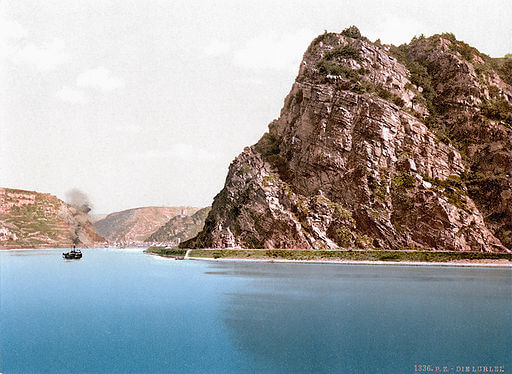
The Loreli along the river Rhine, Germany in 1905. Image from Wikimedia commons. The Upper Rhine Valley is a UNESCO World heritage Site.
Singing nymphs of the Black Forest
The Mummel Lake (MummelSee) in the Black Forest region is a glacial lake said to be created during the last Ice Age, about 10,000 years ago. Now popular with tourists, it has been associated with several myths and legends for a long time. Mummelsee, situated amidst the dark fir trees, is supposedly named after the water fairies or sprites, although in the local dialect ‘mummel’ refers to water lillies. The book ‘Legends of the Black Forest’ by Alex Württemberger, tells the story of the King of Mummelsee who lives underwater , along with several water nymphs who come out on the surface to bathe at night but stay underwater through the day, or as water-lillies on the surface. If the water spirits are angry, the water level seethes, as was the case when a peasant fell in love with a nymph and tried to find out where she came from. Some stories say the nymphs are actually the nuns who once lived in the monastery that stood there. A similar theme is seen referenced here when the monastery is said to have been swallowed by the lake when a nun fell in love with a farm boy.
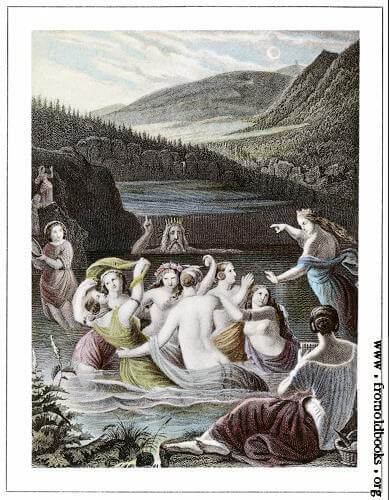
A group of water nymphs bathe in the lake, while the king of Mummelsee appears in the backdrop. Picture courtesy From Old Books. Originally created by Jakob Gotzenberger for Legends of the black forest(1890).
The Pied Piper of Hamelin
If you’ve grown up reading fairy tales by the Grimm Brothers, you are already familiar with a lot of German folklore. One such tale is set in the year 1284 in Hamelin, a town in the Lower Saxony Region of Germany , though it’s not entirely fictional and does seem to have some historical roots. The popular version of the story tells us about the Pied Piper, who helped the people of Hamelin by luring away all the rats from the town, thanks to his flute. However, when he did not receive the full amount of money as promised, he decided to revisit the town to seek revenge. On ‘Saint John and Paul’s Day’ observed on June 26, the piper returned and played his flute to lure all the children away, never to be seen again. Of about 130 children in the town, only one who was lame and hence, slower than the others, could not keep up and was left behind to tell the tale. Some versions state two other kids being left behind – one of whom was deaf and the other, blind. I came across some theories and history behind the story. Turns out that the earliest record of this story was found depicted on a stained glass window of the church of Hamelin, dating back to around 1300 A.D but destroyed later in the seventeenth century. While some people have suggested that the kids might have died due to natural causes and perhaps Death was personified in this tale, other theories link this disappearance to Dancing Mania, a Mass Psychogenic Illness, or even to the children being led by a pagan sect to Coppenbrügge (the Koppen “hills” referred to) where they all perished during a sudden landslide or disaster. The supposed street where the children were last seen is apparently known as Bungelosenstrasse (street without drums), as no one is allowed to play music or dance there. So, the question is: If the story is based on real events, what exactly happened? And could there be any truth in the other fairy tales we’ve grown up reading?
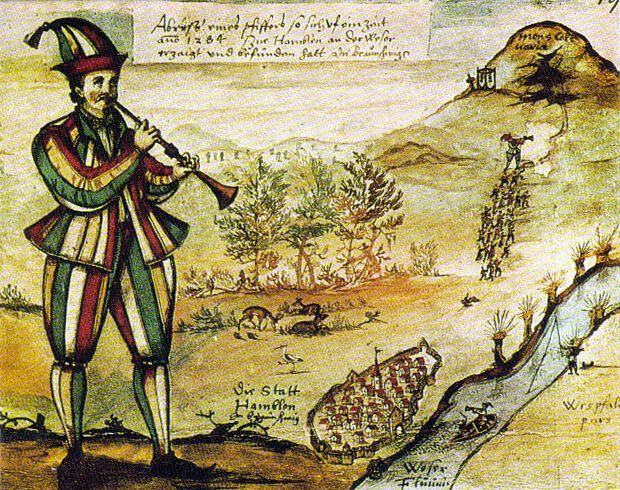
1592 painting of Pied Piper copied from the glass window of Marktkirche in Hamelin.By Creator:Augustin von Moersperg , via Wikimedia Commons
Rumpelstiltskin
In his quest to impress the King, a miller told him how well his daughter could spin – from straw to gold, he boasted at that instant, not aware of what was just going to happen.
This is another story we’ve been reading and hearing, thanks to the collection by Brothers Grimm. It is estimated to date back to about 4000 years ago. As the story goes, a miller , in his quest to impress the King, carelessly boasted about how his daughter could spin straw into gold. The King ordered the girl to be locked up in a room full of straw with a spinning wheel and to spin it all into gold by the very next morning , or else be prepared to face punishment. The young girl was helpless and when she couldn’t figure out what to do, an imp -like creature appeared in the room, saying he could help her out in exchange of something valuable like her necklace. The deal was made and the King was pleased with all the gold he found.However, he ordered for her to be locked up in a bigger room this time and spin all the straw into gold, once again. The imp came to her rescue once more, and helped her out in exchange for her ring. This wasn’t the end of the struggle as the King ordered her to be locked up in an even bigger room , promising to marry her if all the straw was spun into gold. When the imp came to help her, she didn’t have anything valuable to give him, and he made her promise to give him her first born child, whenever that might be. Time flew by and the girl, now the Queen, gave birth to their first child. The imp appeared soon after, asking for her to keep the promise made. She begged of him to take all the wealth he wanted, except the child, and the imp came up with a condition : That if she could guess his name in three days, she wouldn’t have to part with her child. The Queen had no idea of his name and all her attempts on the first two days failed. She ventured out in the forest (or sent a trustworthy officer, depending on the version) and found the imp singing and dancing in the woods, saying his name out loud. “Tonight tonight, my plans I make, tomorrow tomorrow, the baby I take. The queen will never win the game, for Rumpelstiltskin is my name'”. The next day, when the imp came to take the child away, the Queen guessed his name correctly, sending him in a fit of rage, never to be seen again. This story is supposed to have appeared in variations across different cultures and countries, including England, Russia and Iceland.
The Knave of Bergen
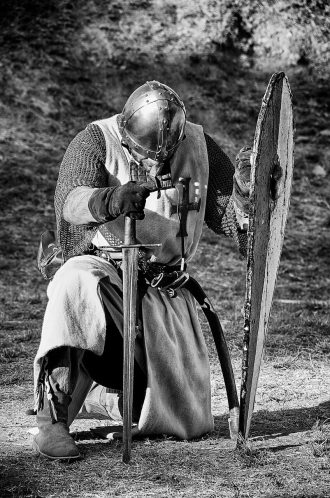
At Frankfort was a great masquerade ball held, in honour of the coronation of the Prince. Knights and Princes, joy and splendour – the atmosphere exuded nobility and fervour. But who was that tall Knight in black armour? How poised, modest and graceful he seemed! Oh and he bowed before the Queen, asking her for a dance, to which she agreed! As she gave her approval for a second, third and fourth dance, the excitement and curiosity in the room increased. Finally, it was the hour of revelation – and all men were obliged to reveal their true selves. Nobody recognized the mysterious guest until two officials gasped in horror – why, it is the executioner of Bergen! How dare he? Enraged, the king ordered for his execution. But, a different plan had he. “Indeed I have heavily sinned…but let me propose a remedy. Draw your sword and knight me and I will throw down my gauntlet for anyone who speaks disrespectfully of thee.” Surprised as much the King was, it did seem wise to him. “Knavish you have acted and Knave of Bergen shall you be.”
I first came across this story 4 years ago in ‘ A Tramp Abroad’ by Mark Twain, referring to ‘Legends along the Rhine from Basel to Rotterdam’ and adapted it from there.
Note – Here’s a glimpse into Frankfurt .
The Spectacular Ruin and the Man of Science
Mark Twain also mentioned Erbach, an hour away from Heidelberg, having a “Spectacular Ruin.” In the Middle Ages, lived and breathed a vicious dragon in the town, devouring men and cattle as he pleased, not defeated or scared by anyone. The Emperor promised any reward as desired, to anyone who could be the destroyer. From far and wide came many knights, but they were all devoured one after the other. And then at last came Sir Wissenschaft, an obscure knight carrying a strangely shaped knapsack. Well, this is not easy, the king remarked. “You could go hunt hares, you know. Why walk into such danger?” “Were any of the heroes men of science?”, he simply asked, to which everybody just raised a laugh. “Don’t be foolish. Take a spear and leave your knapsack”, the King remarked. It isn’t a knapsack, retorted the knight, and “Spears are useless to men of Science.” Saying so, he moved towards the dragon, positioning himself well before slinging his knapsack. Little did they know he had used his brains to his aid, and studied the dragons in a series of experiments. What looked like a strange knapsack contained a modern day fire extinguisher, which he threw right at the centre of the dragon’s mouth, getting him to curl up. Ask what you want, the King exclaimed. “Confer upon me the monopoly of manufacture and sales of spectacles in Germany,” was what he demanded. The King was surprised but kept to his word. The scientist was not selfish and made spectacles accessible for all. The King was so pleased, he ordered them to be bought by one and all, whether the need or not! This was the origin of the “Spectacular Ruin” and oh boy, what a spectacle it was!
Note – If you are visiting the region, here’s why I think you will love visiting Heidelberg
The Morbach Monster
What’s a mythical post without any mention of werewolves or vampires? Well, the town of Wittlich in the Morbach Municipality of Germany is associated with one such folklore. According to the story, a soldier running away from the Russian army with some other deserters, stopped at Wittlich on his way to Alsace, his home. They wanted to grab some requirements from a farmhouse they spotted, but ended up killing the farmer and his sons on getting caught. The farmer’s wife is said to have cursed the soldier, so he would turn into a beast every full moon. Eventually, the news spread of a violent beast and the folks of Morbach were succesful in killing him later. A candle burnt always at the spot where he was buried, as a reminder and warning. However, one night in 1988, the candle went out and the officers at the US airbase at Morbach apparently saw a huge wolf-like figure within the parameter. A chase followed but the military dogs were not succesful in combating the creature. The candle was re-lit after the incident and the story was recounted numerous times since.Now, how much of it was true and what was imagined? It might as well have been the imagination of the three securiy officers at the airbase, probably bored or in need of a new story to tell. But, some of the officers apparently insisted even years later that what they saw was true. A detailed article about the whole scenario can be found here and somebody even sent their personal account to be published on a site covering myths and folklore.
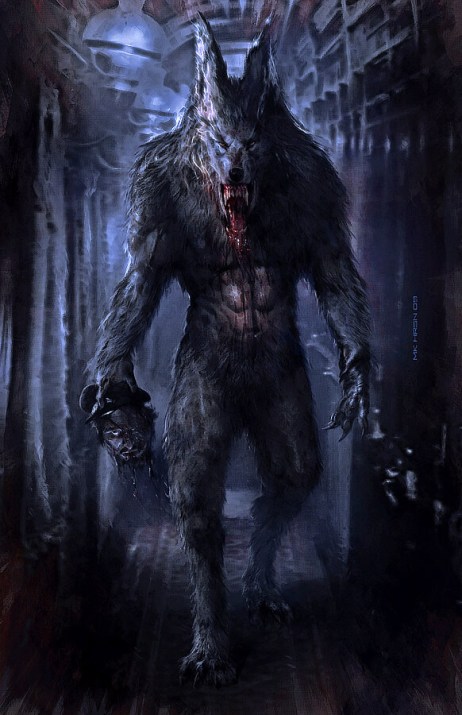
A werewolf – illustrated by Harem Malik.Source:Flickr
The famous pirate and the hidden treasure of Hamburg: Jack Sparrow of Germany?
The streets of Hamburg are rife with the legend of Nikolaus or “Klaus” Störtebeker – a pirate of the North, in the late 14th century, known for looting several Hanseatic ships, being able to gulp down 4 litres of beer at once(hence the surname!), being extremely hard to catch (and also thinking of himself as a Robinhood of sorts, looting from the rich for the poor?). After several years of terrorizing North Germany, legend has it that his ship was finally caught near the island of Heligoland, and the crew was brought to Hamburg for a trial. Störtebeker was given the death sentence, but was granted a final wish before his execution in Grasbrook (now partially known as HafenCity, Hamburg).
“Behead me first, but pardon those who my beheaded body manages to walk past”, is what I imagine him saying to the Mayor! And lo behold, Headless Klaus managed to get up and walk past 11 of his crew members before the executioner made him trip and fall, once and for all…
While the Mayor broke his promise and executed all 73 crew members (including the 11), it is said that some of the treasures from the ship were used to create the tip of St. Catherine’s church in Hamburg . Who knows..maybe some of this lost treasure is hidden under this church too?
If you visit Hamburg, you can see the church and hear about this story during an old town tour, like a Hamburg Discovery Tour or my favourite walking tour for Harry Potter and Magic fans.
You can also find his statue at HafenCity or gulp down beer at the Störtebeker bar at the beautiful ElbphilHarmonie while visiting on you own or by joining a food tour that ends at the Störtebeker restaurant.
Oh, and did you know that in 1878, a skull was discovered in HafenCity, which rose suspicions that it may have belonged to Störtebeker himself! If you hear of more eerie stories during the Haunted Hamburg tour or elsewhere, do keep me posted!
There are many more stories I’d love to read and share. But since that is difficult to fare, I’ll just briefly mention a few other legends and articles I have come across.
- So, apparently, you can find the Devil’s Stone (Der Teufelsstein) at Bollschweil, in the midst of the Black Forest, which is a red stone said to be supplied by the Devil himself for laying the foundation of a fountain, after losing a bet.
- A beech tree in between Wildgutach and Neu-kirch-Fallengrund has got a rather strange connotation to it. A stone bust of Jesus, apparently growing out of it, attracts quite a few pilgrims every year.
- Rhine Maidens or “Rheintöchter” refer to water spirits along the Rhine River and they are often depicted as three sisters.
- The Grimm Brothers lived close to Frankfurt and spent many years travelling around, collecting and compiling stories that we have grown up reading. But, whether or not those stories were intended to be as they are presented currently, is a big question. An article I came across in The Guardian talks about how most of these stories were originally violent and adult in nature, adapted later on for children, as per the changing norms and traditions of the society. So, the evil Queen who wanted Snow White killed was her own mother and Cinderella’s sisters cut up their foot with a knife so as to fit into the glass slipper!
Hope you enjoyed this edition of Mythical Mondays. Please share it with your story-loving and curious friends, save it on Pinterest for future reference and do let me know what other country you might like to see featured in this series.


Discover more from Europe Diaries
Subscribe to get the latest posts sent to your email.
Judith
I love the english name for Hameln 😀 Hamelin sounds so cute and great!
As a German, the stories are of course not new to me, but you have reminded me of many of them or of some of the information. As for the Rattenfänger von Hameln (Pied Piper of Hamelin), I actually know rather different assumptions (please don’t misunderstand, I’m not trying to doubt your information, but I think it’s great that I get even more assumptions, even though I live near Hameln ^^).
I grew up on the German North Sea coast (Ostfriesland), so I still have a kind of personal relationship with Störtebecker, for example, as there is the Störtebecker Tower in Marienhafe (https://www.stoertebekerland.de/seite/372292/störtebekerturm-marienhafe.html). It is said that Störtebecker himself found shelter there.
These things have also been reflected in the fact that I am an author and am working on a pirate series with my co-author, among other things.
So I was all the more pleased to find something about Störtebecker on your site 🙂
On the other hand, I can never get my head around the English name of Rumpelstilzchen (Rumpelstiltskin) ^^’
I’ll look around your blog again in the next few days if I find the time 🙂 So far I’ve only skimmed through everything, I must confess. But before I forget, I wanted to leave a comment.
J
I’ve got a candle to blow out now. Lol. My biological father was apparently raised in Germany. Never met the man though. My favorite tale is of Lorelei. But did you know? Before The story of a Ghost/Nixie it was the story of a Dwarf living inside the rock Lorelei now sits upon. Not entirely sure how it evolved into what it is today.
Erin Janet Chalmers
Are you familiar with folklore about a person who visits from another dimension or time? Three times throughout my life the same woman has visited me in different places around the world and asked me, “What’s the matter Erin? Cat got your tongue?” The visits took place over a 15 year period and she never aged. All three times I was with a family member and near water. I’ve ignored it until recently because it has been heavy on my mind. Someone on Reddit told me about a German word for these types of occurrences and I can’t find the post. It has disappeared. Maybe that’s a sign to leave it alone. Or maybe, I am just crazy. Any insights or ideas would be appreciated.
K :-)
Dear Erin,
I do not know of such myths or legend but I encourage you to ask your ancestors for advice in dreaming. Pose a clear question and see what comes up. You are not crazy and such occurances happen, either from here or another dimension. Thank you for the bravery of sharing. Please, keep dreaming and follow the callings. Aslo, inquire in the message, beyond logic. What sensations and feelings are activated, who or what are you reminded of?
If you have more questions please, comment or place your email below so that I can see your request in my email.
With love, K
Pingback:German Tales ! – German Enthusiast
storylover
I’ve heard of some of these not all but it was good to read them
storylover
this was great information for my project thankyou very much! 🙂
Rainy Days Fun
So interesting, thank you for sharing. I didn’t know all of them, the one I was most familiar one was the Piper one :)) Although to be fair I think I read a child-friendly version long long ago, because I remember him getting rid of the rats but I really do not have any recollection of the second more horrendous part where he took all those kids away!! :O :O :O
reflectiveponderer
Hey! Yes actually I had also been familiar with the kid friendly story but the background and possibilities are so fascinating! Thankyou so much for reading this post and sharing your thoughts. Let’s stay connected!
SruthiSri
This is a fantastic post.
Tanja
I’ve heard of some of these:)
Jessivankat
So cool! I love myths and legends stories! Now I learned new things, thank you for the post
reflectiveponderer
Hey Jessika! Glad you liked it❤️
snowtoseas
I absolutely love myths and legends, so this was a really fascinating read! I hadn’t heard of that Morbach Monster before and it sounds absolutely terrifying.
Laura
This is very neat! Love the graphics you shared along with the stories!
reflectiveponderer
Thanks Laura. Which of these stories was your favourite?