

Eating like a local in Venice: markets, cicchetti and honest prices
The first thing I do in a new city is find its market. Not because I am going to cook, but because a market tells you what the place actually eats, what grows nearby and what the people behind the counters are like before the day has worn them down. In Venice that market is the Rialto, and on a Saturday morning I joined a food tour there led by Rachel from Context Travel. By the end I had tasted fruit, vegetables, sweets and wine, heard a few stories about the historic centre and its workers, and filled a notebook with places to come back to.
Venice rewards this approach more than most cities, because it is easy to eat badly and expensively here if you drift towards the obvious squares. Go early, buy in small quantities, and ask the vendor what they would cook with whatever you are holding. The guide below covers what to eat in Venice, which specialities are worth your money, what to drink, what to carry home and how to avoid the bill that ruins the afternoon.
One more piece of advice before the detail: treat the market as a place to graze rather than to shop. A few strawberries, a piece of cheese, a handful of olives and a biscuit are a better lunch than most restaurant menus within sight of the bridge, and you can eat them sitting on a step with the whole lagoon in front of you.
At the Rialto market, before the crowds
The Rialto Market sits a short walk from the Rialto Bridge and is the main food market on the island of Venice, one of 118 islands in the lagoon. It was an important centre of international trade before the tenth century, and you can still read that history in the square: a fourteenth-century clock that helped merchants keep time, and the old currency exchange house known as the bancogiro, which keeps its name even though it is now an eatery.
The market has two halves. The fish market is the Pescaria; the fruit and vegetable area is the Erbaria. Because the whole thing sits beside the canal and a vaporetto stop, it is normal to see produce being unloaded from boats in the morning. Locals use the market as a meeting point too, catching up with friends before heading to an osteria or a nearby eatery.
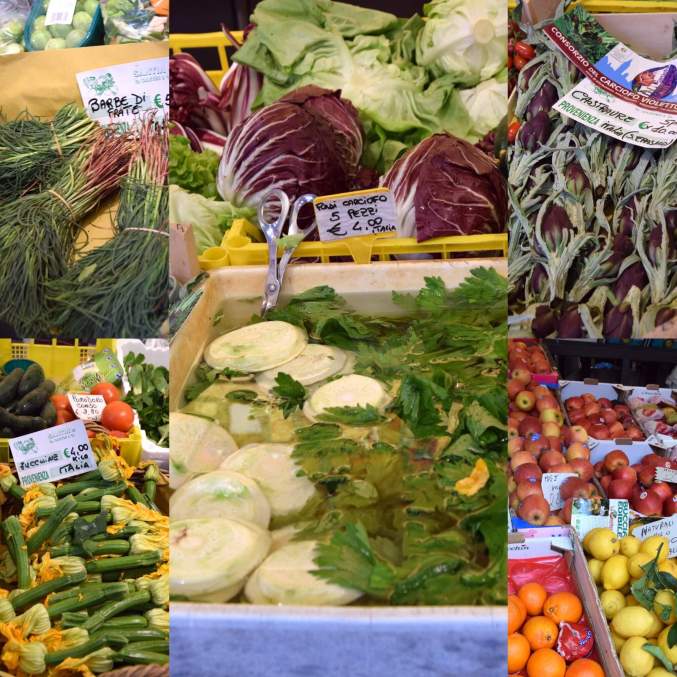
Rachel walked us through the stalls, explaining what grows in the area, what people like to buy and how it gets cooked. A few things stood out.
Artichokes. These appear constantly, and many are grown on Sant’Erasmo, about a thirty-minute ferry ride from the city. They are kept in water at the stalls and cooked in several ways: with hard-boiled eggs in spring, stuffed and roasted, or turned into a pasta sauce.
Asparagus. There is plenty of it, and the white kind is more delicate because it is picked before it breaks the surface of the soil. Boil it simply, or use it in risotto, sandwiches and salads.
Monk’s beard. Rachel introduced us to barbe di frate, also called agretti: a grass-like vegetable grown in spring. I had never heard of it. It tastes something like spinach and can be sautéed or added to pasta.
We bought strawberries, both fragola and the smaller fragolini, and some fennel. I spotted kiwis from Italy, oranges from Sicily, tiny courgettes and tomatoes. Vendors are required to state where each fruit and vegetable comes from, so you know what you are buying. That matters whether you are renting an apartment or staying in a hotel: it tells you what to order in restaurants and what to cook if you have a kitchen.
For the tasting, Rachel bought a selection, washed it at one of the hand pumps that provide drinkable water around the city, laid a mat on a nearby table and cut everything up. I already loved fennel, and I left keen to try her suggestion of a salad with fennel, orange, onion and lettuce.
The Pescaria, and a story about smell
The fish market has operated for seven centuries, and some families have been selling fish there for generations. I am vegetarian, so I did not buy or try any of it, but the range is remarkable: sardines, which take their name from Sardinia, scallops, canoche, squid, octopus, red mullet and monkfish cheeks, among others.
One detail I liked, from a National Geographic piece on the area: the fish market was moved to the other side of the Rialto Bridge in 1459 after wealthy bankers complained to the government about the smell and the noise of the fishmongers. Cities have always negotiated over unpleasant trades, and Venice was doing it six hundred years ago.
Sweet things to carry home
Walk away from the market and you pass grocery shops, bakeries and cafés. The first thing to look for is Buranei, the traditional biscuits from Burano. They come shaped like an S or an O, and some packets mix the shapes. Alessandro from Wanderjack recommended the bakery of Carmellino Palmisano on Burano, though I did not make it there. If you plan to visit Burano and the surrounding islands, a 24-hour travel pass for 20 euros is a sensible buy. There is also a recipe for Buranei if you want to bake them at home.
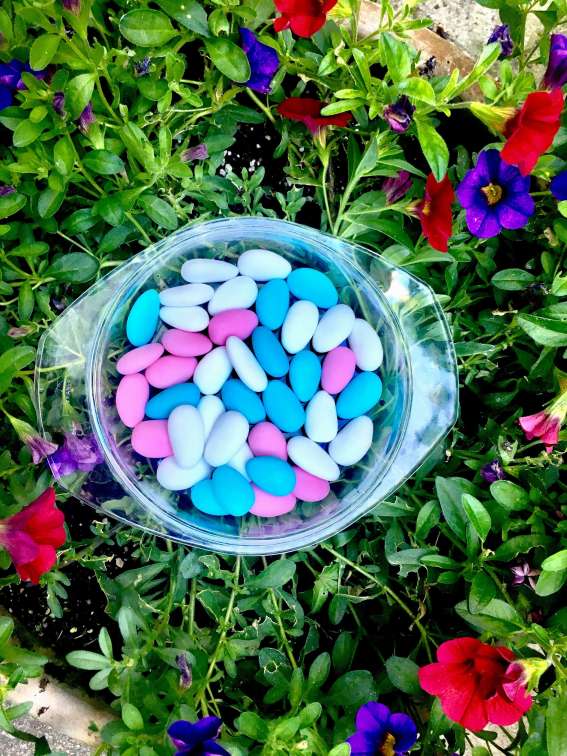
The local treat I did buy, and loved, was confetti: almonds coated in sugar. Rachel explained the traditions attached to them. The colour of a confetto signals an occasion. White is common at weddings, pink marks the birth of a daughter, blue the birth of a son, silver a twenty-fifth anniversary, red a university graduation, and so on. Since none of those applied to me, I bought a mix of three colours on my last day.
One useful word: an etto is 100 grams. If you only want a few, ask for one etto. A hundred grams of these sugar-coated almonds costs roughly 2.50 euros.
Other Venetian sweets worth knowing include balcoli, zaleti and pan del doge.
Cicchetti, and the bar with a boat
No visit to Venice is complete without a stop at a bacaro or osteria for cicchetti and a glass of wine or prosecco. Cicchetti are small snacks or side dishes, the Venetian answer to tapas: slices of bread with various toppings, chosen one by one. You decide the type and number, and a plate of them can easily stand in for a meal. They usually cost between one and three euros each; I remember paying around ten euros for a plate.
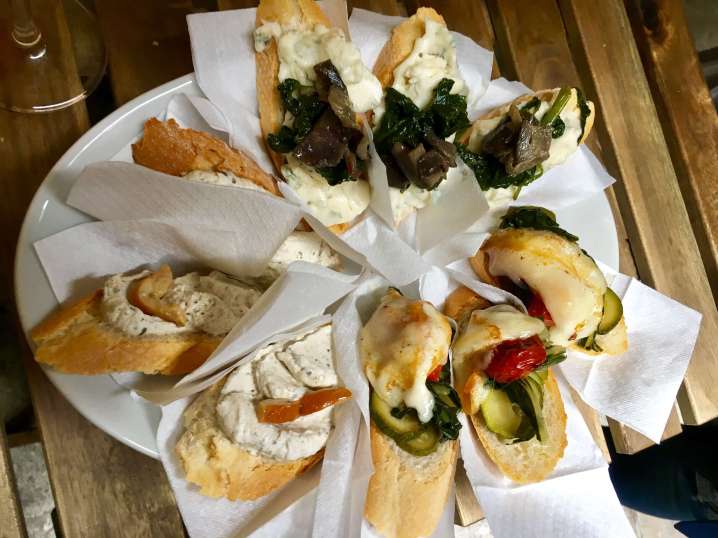
I only tried the vegetarian ones and liked them all, especially one made with Robiola cheese. Another cheese I bought for the apartment and enjoyed was Caprinho.
In a previous post about exploring Venice like a local, I wrote about a bacaro with extra seating on a boat in the open. Sitting on that boat with a plate of cicchetti was an experience in itself, quite apart from the fact that I learned to row on the way there.
What to drink: spritz, prosecco and a Bellini
Wine and prosecco are produced in the region, so if you drink, try them here. For something more structured, there are day trips to vineyards and tastings: the wine tours at Venice Day Trips or a Venice wine tasting tour with Context Travel.
The drink you will see most often is the spritz, the orange, white-wine-based aperitivo available in every bar and restaurant.
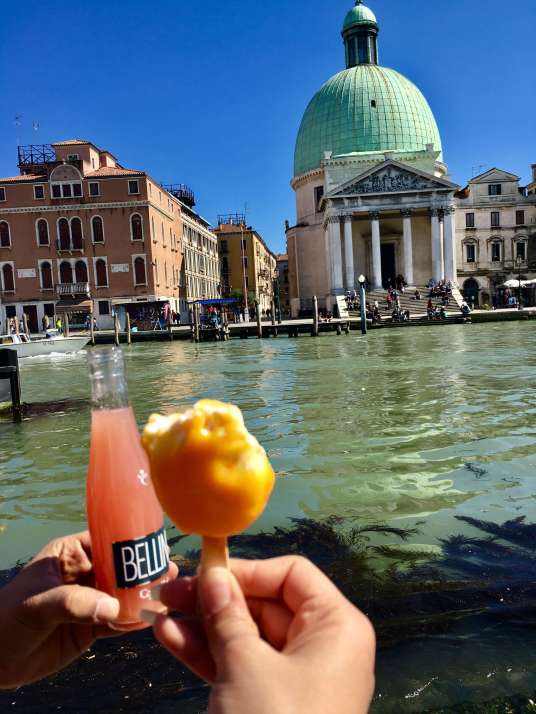
The Bellini is the other Venetian classic, a mixture of peach and prosecco. Its story is a good one. Mixing peach with wine was already known, but when Giuseppe Cipriani combined peach purée with prosecco it became a hit. The colour reminded him of a saint’s robe in a painting by the fifteenth-century Venetian artist Giovanni Bellini, so he named the drink after the painter. You can also buy Bellini in bottles of various sizes.
One warning about beer: check the quantity before ordering a large. A friend asked for one and was presented with a litre jug, which brought back memories of Oktoberfest.
Eating out without being fleeced
Venice is a tourist city, and the gap between a good value meal and an expensive disappointment can be one street. Some rules I picked up:
- Choose the area carefully. Prices vary enormously. A coffee at St Mark’s Square will cost far more than the same coffee elsewhere, and anywhere with live music adds a cover charge to everything. Residential areas such as Cannaregio or Campo Santa Margherita are cheaper and often better.
- Decide whether to sit or stand. Sitting down brings a cover charge and higher prices. Ask about every extra before you take a seat. A fixed charge of two euros is easier to accept than ten to fifteen per cent of the bill. Some places hand you a more expensive menu if you are served by a waiter, so compare self-service and table service before choosing. Tipping is not customary, which is why these charges exist.
- Drink the water. Drinking fountains are all over the city, so carry a bottle. Restaurants may charge five euros simply to fill your glasses with mineral or filtered water.
If you want tap water, ask for “acqua semplice” or “acqua da rubinetto”. For sparkling mineral water, “acqua minerale gassata”; for still, “acqua minerale naturale” or “non gassata”.
What to order, vegetarian or not
Being an island, Venice has a great deal of seafood: sarde in saor, risotto with squid ink, cod dishes, crab and molluscs. If you eat fish, that is where the city’s reputation rests.
If you do not, look for pasta, gnocchi and risotto.
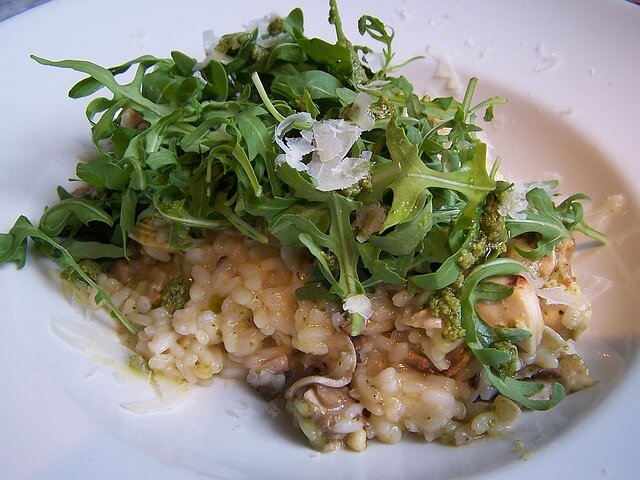
Polenta is popular too, and was once the staple food of many farmers; there is an interesting post on polenta and Venice worth reading. I hoped to try lasagne in Venice but never found a vegetarian version.
Italian cheese is some of the best in the world, and Parmesan has a useful property: because the bacteria in aged cheese consume the lactose, it suits many people who are lactose intolerant. Local vegetables are another guide to the menu, so if you see asparagus or artichoke dishes, order them. Cicchetti and bruschetta are reliable vegetarian choices.
You might expect pizza, and I have had my best pizza in Florence, but Venice is not known for the traditional kind: wood-fired ovens are not allowed on the island. Pizza is still sold in every restaurant and is affordable as a takeaway.
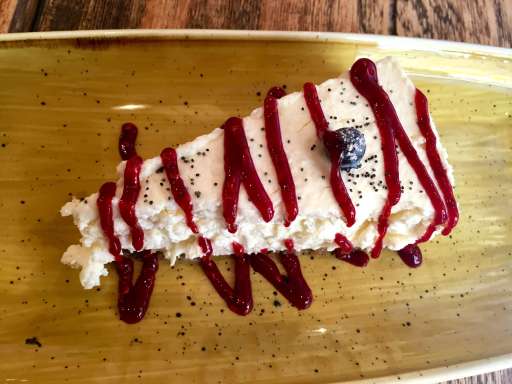
For dessert, tiramisu is the Italian speciality to try. Near San Pantalon I also found a very good blueberry cheesecake, although cheesecake did not originate in Italy.
Takeaway, and the Carnival fritter
If you do not want to sit down, Venice has plenty of takeaway. Pizza is the obvious choice, by the slice or whole, eaten on a canal edge or while walking. There are also sandwiches, fried food and, for non-vegetarians, meatballs. Around Carnival, bakeries sell a sweet fritter that I heard good things about but did not manage to try.
Where locals sent me
I asked people in Venice where they would eat, and these were the answers. I did not manage to visit most of them, so treat this as a list to test rather than a set of reviews.
Rachel, who works with Venice Day Trips and Context Travel, recommends Vineria all’Amarone near the Rialto Bridge, Trattoria Promessi Sposi in Cannaregio, Al Prosecco at Campo San Giacomo dell’Orio, and Osteria Alla Staffa in Castello.
Elena from Wanderjack suggests Paradiso Perduto and Remer, both in Cannaregio, Antica Osteria Ruga Rialto in San Polo and Ristorante Da Fiore, also in San Polo.
For more ideas, there are lists here and here.
My thanks to Context Travel for inviting me on the food tour, and to everyone who answered my questions and sent suggestions. Context is a network of scholars and specialists who design and lead small-group walking tours for curious travellers, and the Rialto market walk was a good example of why that format works: you learn less from a menu than from the person who sells the artichokes.
The numbers, in one place
Prices in Venice move, but these are the figures I noted and the ones worth remembering when you are deciding where to stop:
- Confetti: roughly 2.50 euros for 100 grams, which is one etto.
- Cicchetti: one to three euros each, with a generous plate costing around ten euros.
- A 24-hour vaporetto pass: 20 euros, useful if you plan to visit Burano and the other islands.
- Cover charge: a fixed two euros is preferable to ten to fifteen per cent added to the bill.
- Water: refill free at the city’s drinking fountains rather than paying up to five euros at the table.
Venice is a city I would happily return to with an empty stomach and no plan. If you have a favourite bacaro or a dish I missed, leave it in the comments. And if you found this useful, pass it on to someone who is planning a trip.
Discover more from Europe Diaries
Subscribe to get the latest posts sent to your email.
Erica
Great post! Thank you for the great advice. It can be difficult to figure out where to eat and what is authentic in popular cities like Venice, so I appreciate you sharing this information. I will be using this next time I’m in Venice!
Tanie Bilety
colorfull marketplace, i loce this
Livi Bee
This is a very useful guide!! I can’t wait to visit Italy!!! It’s funny that you have a section titled “how to not get ripped off.” I thought you were going to mention something along the lines of local prices vs tourist prices, but clearly it is beyond that!! I’m definitely pinning this for when I visit.
Daniela || Ipanema travels to
Oh, I love the ciccheti and I dye for late afternoon Spritz! Great post! Now I have to head to the fridge and fetch me a Campari…
Amy - Page Traveller
*Sigh* I love Venice. I’ve been to the city twice and spent a lot of time in the Veneto region. It’s such a gorgeous part of Italy. Thanks for sharing – this really made me miss Italian food!
Minna
Such a thorough guide! Food plays a massive part of my travel experience so it’s always great when I come across posts like this! If I ever make it to Italy I know what to look for now!
Jamie Joyner
Yum! It’s nice to have a list of local eateries – that’s where the good stuff is!
Sonika Agarwal
Wow. Venice seems like one food paradise. I wanna taste the juicy strawberries too.
reflectiveponderer
Same here❤️
Genie | Gallivanting Bean
awesome guide to food in venice. definitely have to have the bellini. I’m already missing all the great coffee there too!
reflectiveponderer
I get you,girl! When were you last in Venice?
Holly
I think when traveling it is so important to immerse yourself in the culture. All of this local food looks so delicious!
reflectiveponderer
So agree with you,Holly. Where are you off to next?
Danielle Jones
Thankyou for sharing, very interesting. The food looks delicious!
reflectiveponderer
So much of deliciousness all around for sure!
CreativeTravelGuide (@CTGTravelGuide)
This is such a comprehensive guide – thank you so much!! I am planning a big Italy tour in the near future and I will be honest, Venice worries me because of how popular and busy it can be. This post is so helpful though and I will definitely check these local restaurants out and that amazing market!
reflectiveponderer
Thanks so much! I’m glad you found it useful. Hope this helps you plan your trip better:)